Integrations
AI Usage SIEM Streaming
Stream a record of every AI interaction through your gateway into Splunk, Elasticsearch, Datadog, or your own HTTPS collector. Your security team can then investigate policy decisions and data-leakage findings next to the rest of their security events.
A destination can also receive Trail events, the audit log of the control plane. Verdictan keeps Trail events for 90 days. Forward them to a SIEM to keep them for longer.
Connected gateways capture AI Usage Records automatically. Add a destination in the Console to forward these records. Then send a test request and find its record in your SIEM.
Before you start
- Verdictan CLI 0.1.16 or later.
- A connected gateway with its bound gateway runtime token in
VERDICTAN_API_TOKEN. A personal API token cannot send these records. - The
ai_usage_stream:writepermission to create a destination. Useai_usage_stream:readto examine delivery health. Useai_usage_stream:adminto delete a destination. - A destination that accepts HTTPS ingestion from the Verdictan control plane.
Capture
Capture is always on for connected gateways. You cannot disable capture or set a body capture limit.
- Capture includes chat completions, messages, responses, embeddings, audio, completions, moderations, WebSocket sessions, and MCP requests. Blocked requests and upstream errors also produce records.
- Each record contains the full request and response bodies. Binary bodies use lossy UTF-8 text. The SHA-256 hashes cover the raw bytes.
- Before dispatch, the gateway checks its write-ahead log (WAL). If the WAL cannot accept records, the gateway returns
503withaudit.wal_unavailable. - If capture fails for a buffered response, the gateway returns
503withai_usage.capture_unavailable. - If capture fails after streaming starts, the gateway logs the error. It cannot replace output that the client already received.
- The gateway sends records to
POST /v1/machine/ai-usage-stream/ingest. - The control plane stores records even when no destination exists. It has no retention period for these records.
Large bodies increase memory and disk use. The WAL has a total capacity of 1 GiB by default. Network proxies and destinations can have separate request size limits.
A gateway without a control-plane connection logs a startup warning. It serves traffic without capture.
The policy config has no capture settings. policy lint and the control plane reject the ai_usage_streaming section. A running gateway ignores this legacy section and logs a warning.
Set the destination and its redaction mode in the Console.
Configure a destination
- In the Console, open Settings → SIEM Streaming and select Add Destination.
- Enter a Name, and pick a Destination type:
splunk,elastic,datadog, orgeneric_https_json. - Enter the destination's HTTPS ingestion URL in Endpoint URL, and its credential. The control plane encrypts the credential before storing it.
- Under Record Streams, keep AI usage records selected. To also send Trail events, select Trail events. See Forward Trail events.
- Keep Redacted Mode (Default) for the first test; request and response bodies are replaced with
[REDACTED]. Read Redaction modes before you choose raw. - Leave Event Filter empty until delivery works. See Event filters.
- Select Create Destination.
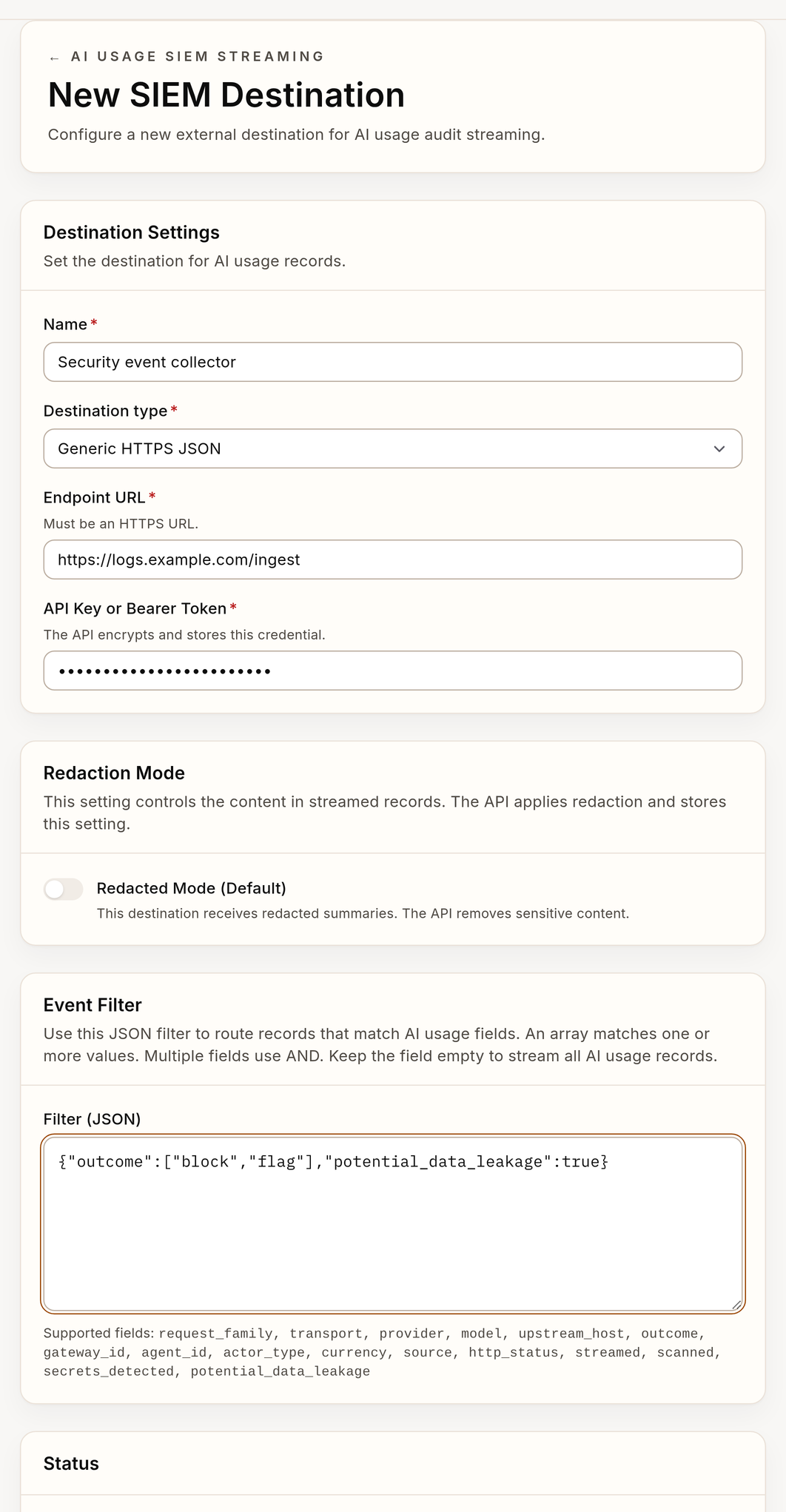
The SIEM destination form with synthetic data and redacted mode.
The API checks the type, URL, credential, redaction mode, and filter. Raw mode without the acknowledgment fails with destination.raw_requires_acknowledgement. A URL that breaks the outbound URL policy fails with destination.ssrf_denied.
Verify
- Send one clearly labeled request through the gateway, such as
Reply with Hello. SIEM delivery check., and note its request ID and time. - Open the destination in the Console. For AI usage records, the Delivery Health card shows Pending, Sent, Retrying, Quarantined, Last Delivery, Delivery Lag, and the last error. For Trail events, it shows Delivered Events, Last Event Time, Last Delivery, Failed Batches, Next Attempt, Last HTTP Status, and the last error.
- From the API,
GET /v1/ai-usage-stream/delivery-healthreturns, for each destination,pending_count,sent_count,retryable_count,quarantined_count,last_sent_at,last_error, andlag_seconds. - For attempt details,
GET /v1/ai-usage-stream/destinations/{id}/delivery-statusreturns the 50 most recent attempts withphase,http_status,error_code,error_summary, anddelivery_duration_ms. - In the SIEM, search for the record's
record_id, and check thatredaction_mode_appliedand the body fields match the destination's mode.
Supported destinations
| Type | Target system | Credential header | Content type |
|---|---|---|---|
splunk | Splunk HTTP Event Collector | Authorization: Splunk <token> | application/json |
elastic | Elasticsearch bulk API | Authorization: ApiKey <key> | application/x-ndjson |
datadog | Datadog logs intake | DD-API-KEY: <key> | application/json |
generic_https_json | Any HTTPS JSON collector | Authorization: Bearer <token> | application/json |
Any other type is rejected, including syslog, s3, splunk_hec, and datadog_logs.
Every delivery is an HTTPS POST with an Idempotency-Key: <record_id>:<destination_id> header. The body depends on the type:
splunk: one NDJSON line per record,{"event": <record>, "sourcetype": "verdictan:ai_usage", "source": "verdictan-api"}.elastic: bulk NDJSON, anindexaction with_index: verdictan-ai-usageand_id: <record_id>, then the record.datadog: a JSON array of{"ddsource": "verdictan", "service": "verdictan-ai-usage", "message": <record>}.generic_https_json: one object,{"source": "verdictan", "schema_version": "1", "stream": "ai_usage", "records": [<record>]}.
The endpoint must use https:// with no user information in the URL. The control plane checks it against its outbound URL policy when you save the destination and again before each delivery, and rejects private, loopback, link-local, and other restricted addresses.
Destination endpoints
| Type | Endpoint URL example | Credential |
|---|---|---|
splunk | https://splunk.example.com:8088/services/collector/event | An HTTP Event Collector token |
elastic | https://elastic.example.com:9200/_bulk | An API key that can write to the verdictan-ai-usage index |
datadog | https://http-intake.logs.datadoghq.com/api/v2/logs | A Datadog API key for the site that owns the intake URL |
generic_https_json | Your collector's HTTPS ingestion URL | A Bearer token your collector accepts |
Redaction modes
Each destination has one mode, which decides what request and response content leaves Verdictan:
| Mode | What the destination receives |
|---|---|
redacted (default) | request_body and response_body are [REDACTED], and redaction_mode_applied is redacted. Detector findings and SHA-256 hashes stay. |
raw | The full captured bodies. The acknowledgment time is stored in raw_acknowledged_at. |
Redacted mode is enough for most investigations: each finding keeps its category, entity type, confidence, matched policies, and masked evidence locations, so an investigator can see what was detected and what the gateway did.
Raw mode sends unredacted prompts and responses to an external system. Confirm the destination's access, retention, and data-handling controls before you save it.
Event filters
An optional event_filter decides which records a destination receives. Every record is stored regardless; the filter only controls whether a delivery is created for that destination.
- An empty, missing,
null, or{}filter matches everything. - With several fields, all must match.
- An array matches when the record's value equals one of its entries.
- Unknown fields, empty arrays, empty strings, and
http_statusvalues outside 100–599 are rejected.
| Field | Match |
|---|---|
request_family, transport, provider, model, upstream_host, outcome, gateway_id, agent_id, actor_type, currency, source | Exact match against a string array |
http_status | Exact match against an integer array |
streamed, scanned, secrets_detected, potential_data_leakage | Exact Boolean match |
Only blocked or flagged OpenAI records with a data-leakage finding:
{
  "provider": ["openai"],
  "outcome": ["block", "flag"],
  "potential_data_leakage": true
}
Only upstream throttling and server errors:
{
  "http_status": [429, 500, 502, 503, 504]
}
AI Usage Record schema
Each record carries identifiers, content metadata, governance findings, and usage. Use request_id to find an interaction, record_id to deduplicate deliveries, and trail_event_id to join Trail evidence.
Expand the complete record field reference
Envelope and identity
| Field | Description |
|---|---|
schema_version | The record schema version |
record_id | The unique record identifier (UUID) |
org_id | The organization identifier |
sequence | The monotonic sequence number in the organization |
captured_at | The server-owned capture time |
source | The capture source. The value is gateway |
gateway_id | The gateway that processed the interaction |
agent_id | The agent identifier |
subject_token_id | The client API token that the request used |
actor_id, actor_type | The actor identity and type |
session_id | The session identifier |
correlation_id | The cross-system correlation ID |
request_id | The unique request identifier |
Interaction and content
| Field | Description |
|---|---|
request_family | The request family, such as Chat, Responses, Messages, WebSocket, or MCP |
transport | The transport: buffered, sse, websocket, or mcp |
provider, model | The provider and model |
upstream_host | The upstream host without credentials |
streamed | true when the gateway streamed the response |
started_at, completed_at | The start and completion times |
latency_ms | The total latency in milliseconds |
outcome | The governance outcome: allow, block, flag, or error |
http_status | The upstream HTTP status code |
request_body, response_body | The captured content. In redacted mode the value is [REDACTED] |
request_bytes, response_bytes | The content byte counts |
request_sha256_raw, response_sha256_raw | The SHA-256 hashes of the raw content |
request_sha256_redacted, response_sha256_redacted | The SHA-256 hashes of the redacted content |
request_truncated, response_truncated | Always false. The gateway captures the full content |
Governance and data leakage
| Field | Description |
|---|---|
matched_policies | The policy controls that matched the interaction |
decisions | The applied governance decisions |
applied_mutations, applied_redactions | The changes that the gateway applied to the request or response |
output_stage_evaluations | The output-stage evaluation results |
human_oversight, escalation, flagged_review | The oversight references |
detectors[] | The detector findings. Each entry has detector, category, entity_type, match_count, confidence, matched_policy_ids, action, evidence_locations, and sample_hash |
scanned | true when the detector check completed |
secrets_detected | true when a scanner found a credential or secret pattern |
attachments[] | The file metadata: type, size, sha256, and scanned |
potential_data_leakage | true when the gateway detected possible data leakage |
redaction_mode_applied | redacted when the control plane removed the bodies before delivery |
The evidence_locations value contains only offsets and hashes. The sample_hash value is a non-reversible hash of the matched content. An empty detectors[] with scanned: true shows that the check found no reportable match in its configured limits.
Financial and integrity
| Field | Description |
|---|---|
prompt_tokens, completion_tokens, cached_input_tokens, total_tokens | The token counts |
cost, currency | The interaction cost and currency |
wallet_transaction_id, budget_id, reservation_request_id, spend_log_id | The financial references |
canonical_sha256 | The RFC 8785 canonical hash of the record |
trail_event_id | The Trail event that correlates with the record |
Limits
- Delivery is at-least-once. Failed deliveries retry with exponential backoff; after five failed attempts the delivery is quarantined, and later records keep flowing.
- Records are sent in order per destination, but a retried record can arrive after a newer one. Deduplicate on
record_idandcanonical_sha256. - The record and its deliveries are stored in one transaction. No delivery is created for a destination whose filter doesn't match.
- Records have no size limit. A destination that limits event size, such as Splunk HEC or Datadog logs, can reject a large record. The delivery then retries and is quarantined.
- The destination credential never appears in an API response.
Forward Trail events
The streams field of a destination selects the records that it receives:
streams | The destination receives |
|---|---|
["ai_usage"] (default) | AI Usage Records |
["trail"] | Trail events |
["ai_usage", "trail"] | Both |
A destination with the trail stream needs the org:trail:admin permission in addition to the AI usage stream permissions. You need it to create, change, or delete such a destination.
In the Console, select Trail events under Record Streams when you create or edit the destination. From the API, set streams:
curl -X POST "$VERDICTAN_API_URL/v1/ai-usage-stream/destinations" \
  -H "Authorization: Bearer $VERDICTAN_API_TOKEN" \
  -H "Content-Type: application/json" \
  -d '{
    "kind": "splunk",
    "name": "Splunk audit",
    "endpoint_url": "https://splunk.example.com:8088/services/collector/event",
    "secret": "<HEC token>",
    "streams": ["trail"]
  }'
To add Trail events to an existing destination, send PUT /v1/ai-usage-stream/destinations/{id} with "streams": ["ai_usage", "trail"].
How Trail forwarding works
- A new Trail destination starts at the oldest retained Trail event. It receives all the retained events, and then each new event within a few seconds.
- Verdictan sends Trail events in sequence order, in batches of up to 100 events. The
Idempotency-Keyof a batch istrail:<destination_id>:<first_sequence>-<last_sequence>. - When a batch fails, the destination keeps its position. Verdictan sends the same batch again after a backoff that increases from 5 seconds to 1 hour. Later events wait for the failed batch.
- Verdictan deletes Trail events after 90 days. If a destination fails for longer, the events that expire are not forwarded.
- The
event_filterapplies only to AI Usage Records. A Trail destination receives all Trail events. - Changing the endpoint URL does not send the earlier events again. To send all retained events to a new system, create a new destination.
Trail record format
Each Trail record has the fields of GET /v1/trail/events/{id}, and these fields:
| Field | Value |
|---|---|
record_id | The event_id of the event |
canonical_sha256 | The record_hash of the event |
stream | trail |
Use sequence_number, previous_hash, and record_hash to check the hash chain in your SIEM. Deduplicate on record_id.
The redaction mode of the destination controls personal data:
| Mode | Trail record |
|---|---|
redacted (default) | actor_email, source_ip, peer_ip, and user_agent are null, and redaction_mode_applied is redacted. actor_id stays. |
raw | All fields. |
The wire format is the same as for AI Usage Records, with Trail labels:
| Type | Trail label |
|---|---|
splunk | "sourcetype": "verdictan:trail" |
elastic | _index: verdictan-trail. The API key must be able to write to this index. |
datadog | "service": "verdictan-trail" |
generic_https_json | "stream": "trail" |
Check Trail delivery
GET /v1/ai-usage-stream/delivery-health returns a trail object for each Trail destination:
| Field | Meaning |
|---|---|
last_sequence | The last Trail sequence number that the destination acknowledged |
last_event_time | The event time of that event |
last_delivered_at | The time of the last successful batch |
delivered_count | The Trail events that the destination acknowledged |
attempt_count | The consecutive failed batches |
next_attempt_at | The earliest time of the next batch |
last_error, last_http_status | The result of the last failed batch |
Compare last_sequence with the newest sequence_number in Trail to see how far the destination is behind.
Next steps
- Trail and Audit Evidence: join a record to its Trail event with
trail_event_id. - Reviewing Alerts and Evidence: investigate the flagged and blocked interactions your SIEM surfaces.